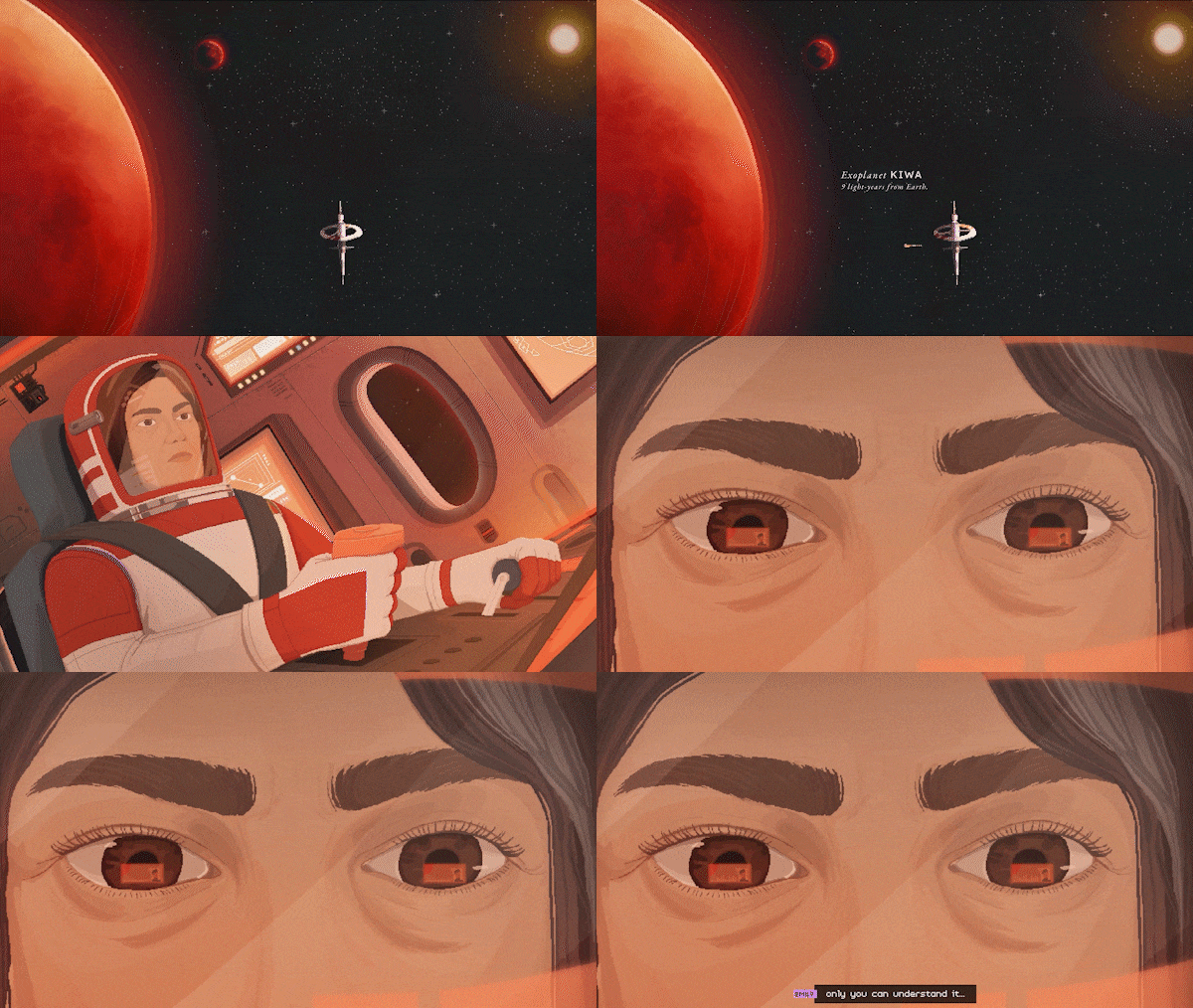
Red Dreams: A Māori Journey Among the Stars
There is an image that has haunted me since I first conceived Red Dreams: a tiny vessel surrounded by an infinite void, its crew cut off from everything they have ever known, navigating by instinct, by stars, and by sheer human will.
Most people, when they imagine deep space travel, think of big spaceships and rockets. I thought of a waka, the legendary Māori canoes.
The Māori were the greatest navigators in human history. Centuries before any European ship had dared cross the Pacific, Māori ancestors crossed thousands of miles of open ocean in wooden canoes, guided only by the stars, the currents, and an intimate understanding of the natural world. They did not conquer the unknown through technology. They conquered it through courage, community, and an unshakeable connection to their identity.
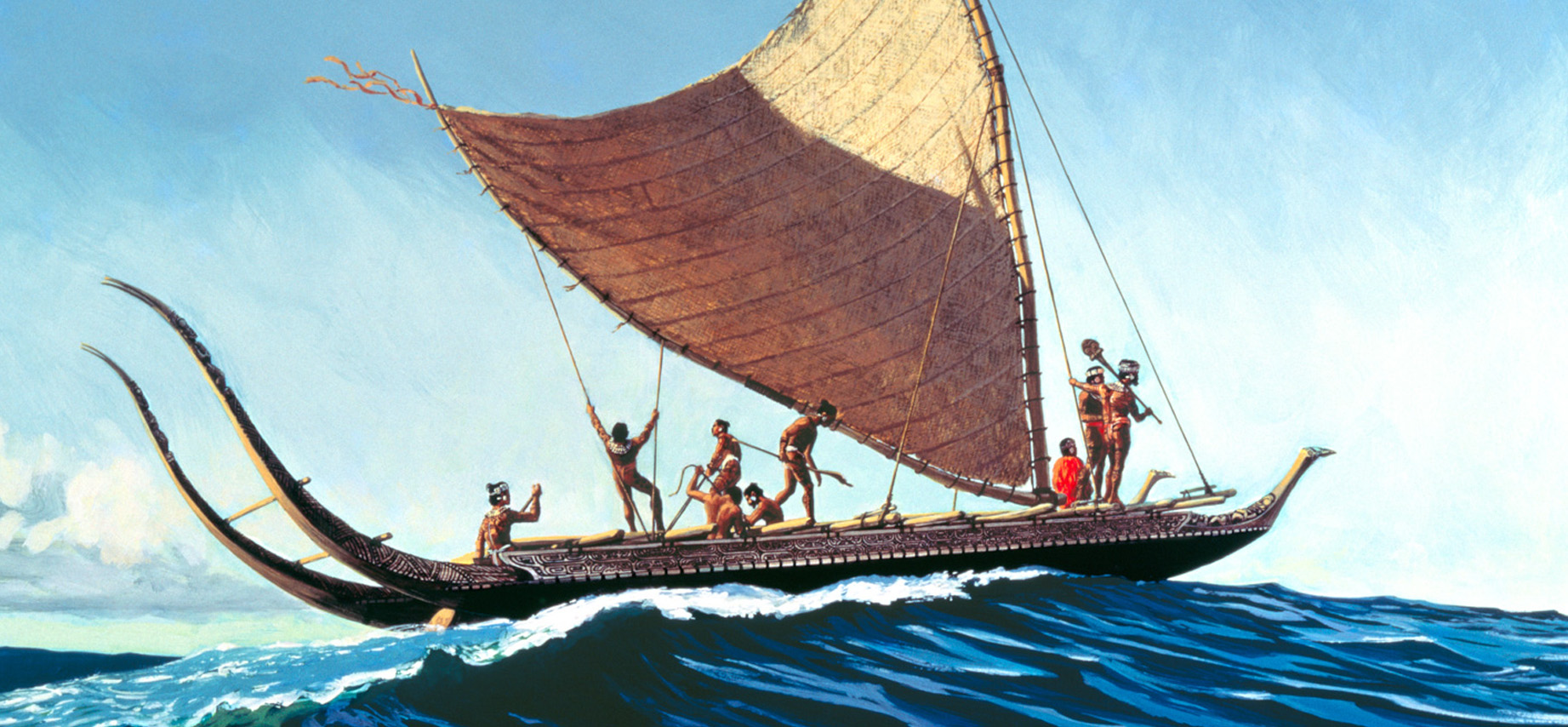
The Māori Waka is the ultimate embodiment of human adventure and exploration.
That is the same impulse that drives us to point telescopes at distant stars and dream of going there. The explorer who crosses a dark ocean in a small boat and the astronaut who crosses the void in a small capsule are the same person, separated by centuries and the size of their ocean.
For the cultural framework for Red Dreams, I did not have to search for long. The Māori were already there, waiting at the intersection of exploration, identity, and the unknown.
The Māori explorer who crosses a dark ocean in a small boat and the astronaut who crosses the void in a small capsule are the same person.
A Love Story That Began in 1990
I was twelve years old when I fell in love with New Zealand. It was a documentary series called The Moa's Ark, presented by the British naturalist David Bellamy. In 1990, New Zealand was, for most people in Spain, little more than a distant rugby team famous for their haka. The world was a much larger place then, before the internet made everything reachable and, in doing so, made everything slightly less magical.
That series changed something in me. Bellamy followed the ghost of the extinct Moa bird across New Zealand, landscapes unlike anything I had ever seen: fjords that looked carved by gods, forests that seemed to breathe, a sky that felt closer to the stars... And woven through all of it, the Māori: their art, their language, their mythology, their presence in the land as something inseparable from the land itself.
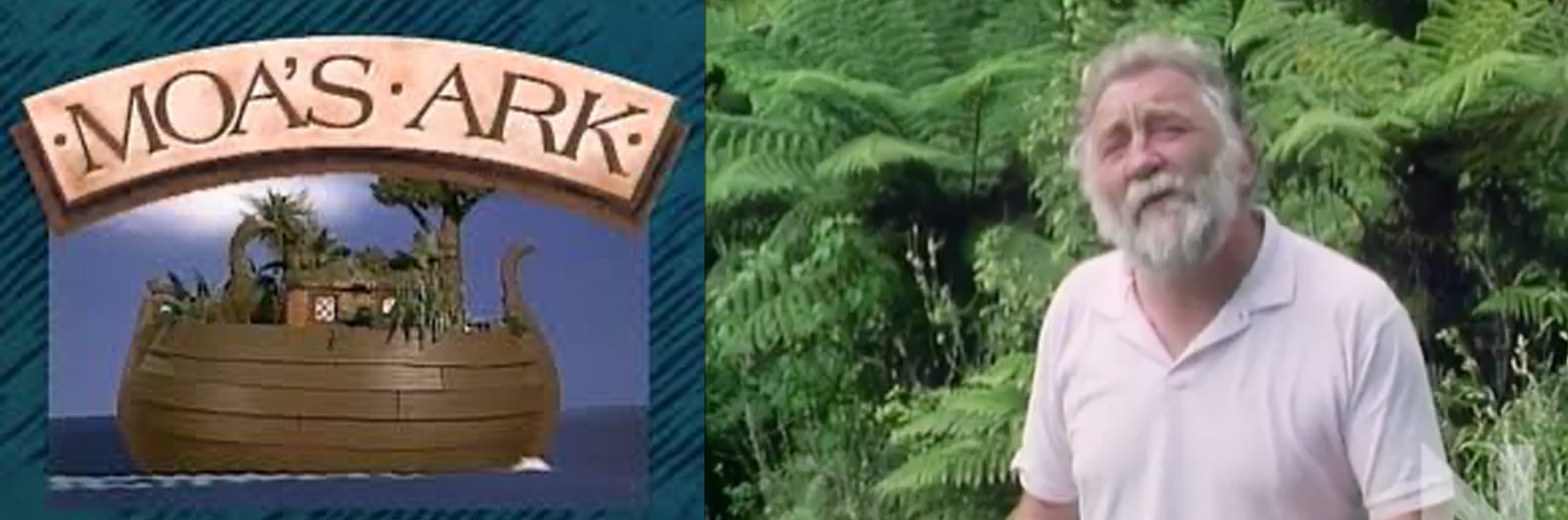
Images from the documentary series Moa's Ark, by naturalist David Bellamy.
I grew up reading Gerald Durrell, one of the most important naturalists, who had a great sense of humour.Like Durrell, Bellamy had a passion that made you instantly love whatever he was showing you.
Ever since watching that TV documentary, I've loved New Zealand. As I read more and watched films and documentaries about Māori culture, I always had the same question, the one that still keeps me up at night: how did the first Māori reach Aotearoa (New Zealand)? How did they know, standing on an island in Polynesia with nothing but ocean in every direction, that there was something worth sailing toward?
That question is the beating heart of Red Dreams.
How did the first Māori reach Aotearoa (New Zealand) with nothing but ocean in every direction?
Māori Art: A Bridge Between Two Worlds
Māori art has always struck me as one of the most emotionally complex visual languages ever created. It is intricate and geometric, yes, but it carries something underneath the patterns: a kind of melancholy, as if it is always looking back at another time, mourning something beautiful that cannot be retrieved.
The koru, the spiral that represents new life and growth, is also the shape of something curling inward, returning to its origin. The tā moko, the facial tattoos that carry a person's genealogy and identity, are simultaneously a declaration of who you are and a reminder of everyone who came before you. Māori art does not let you forget where you came from, even when you are trying to go somewhere new.
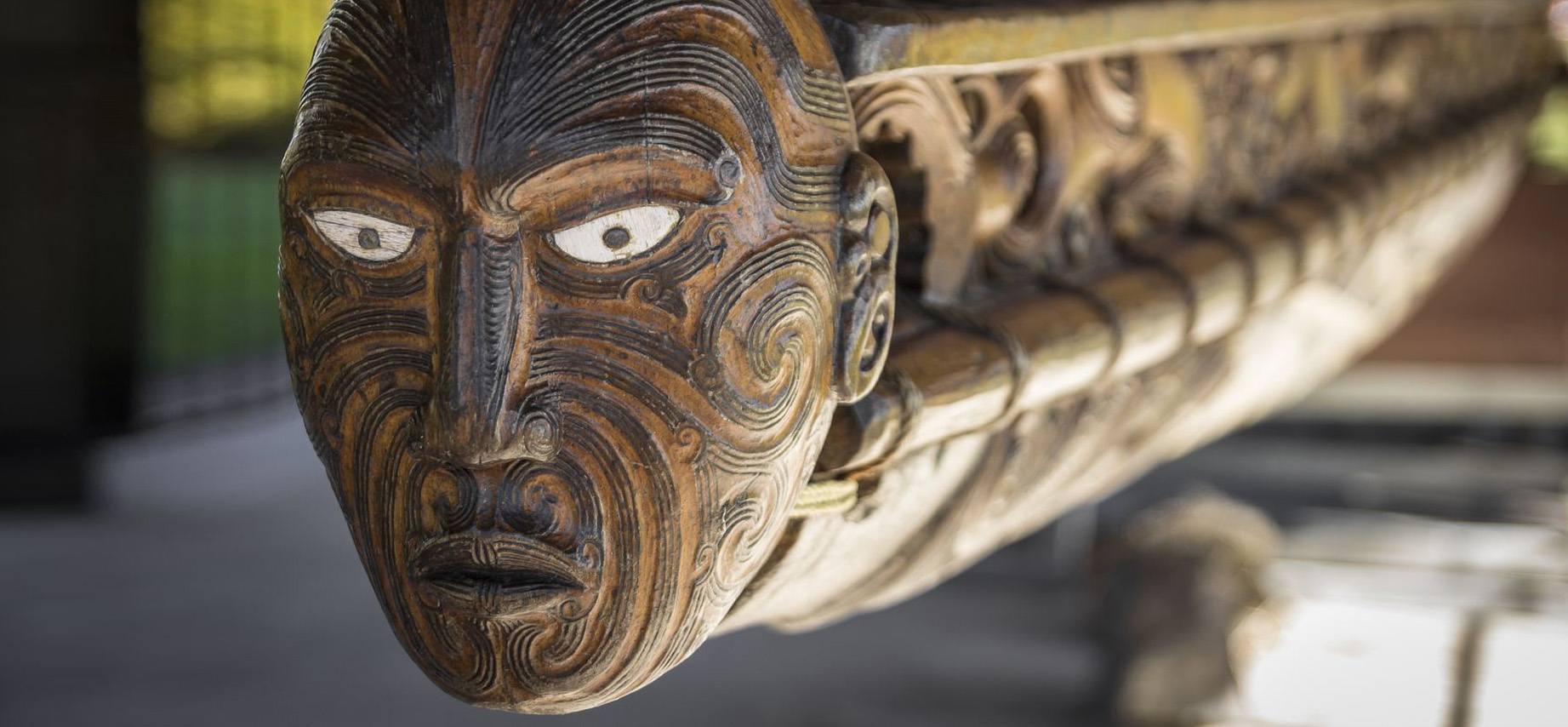
The beauty of Maori art in the details of a canoe.
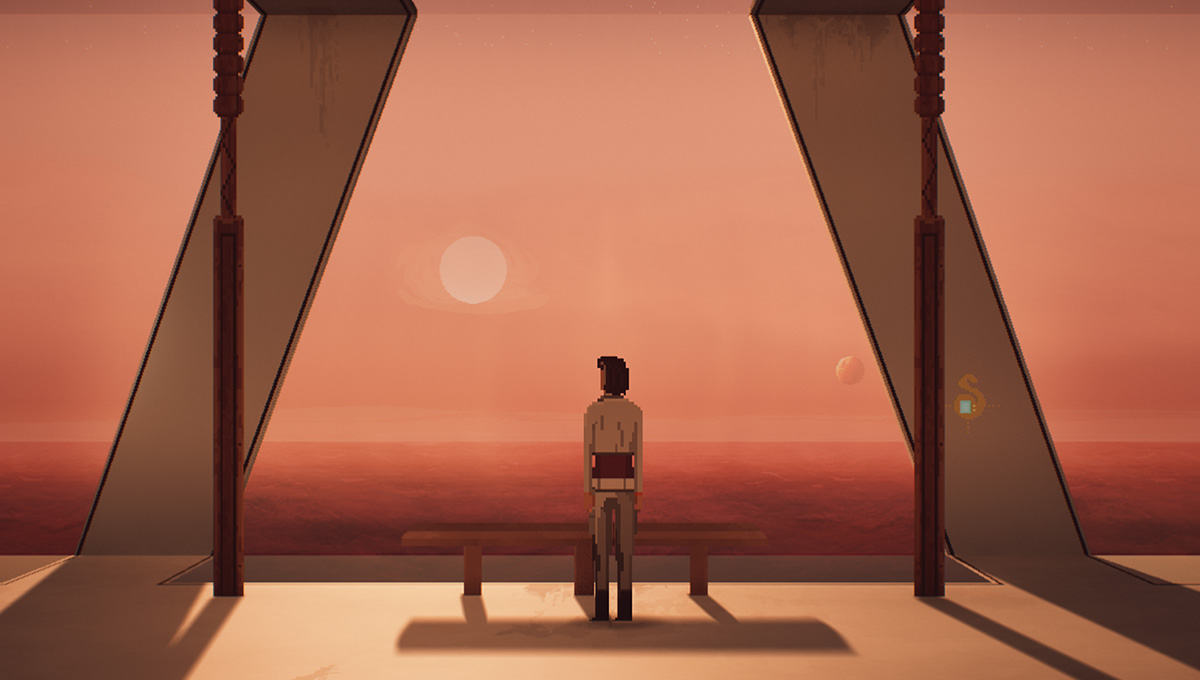
That tension is exactly what I needed for the Taniwha station in Red Dreams. The station is a technological marvel: a research platform floating above a vast red ocean on an exoplanet light-years from Earth. But its walls are covered in Māori patterns. Its architecture echoes the traditional meeting houses. In the middle of the most alien environment imaginable, the crew has brought home with them, carved into every surface.
It creates a deliberate dissonance. Technology and ancient design should not coexist this naturally, and yet they do, because that is what humans do: we carry our past into our future because we cannot survive without it. The Taniwha station embraces simultaneously what we were and what we might become, as if we are constitutionally incapable of living only in the present.
There is also something specific about Māori visual art that functions differently in a science fiction context: it does not look out of place among the stars. The sweeping curves, the precise geometric repetition, the sense of something vast and ordered beneath the surface. It looks, somehow, like it was always meant to be there.
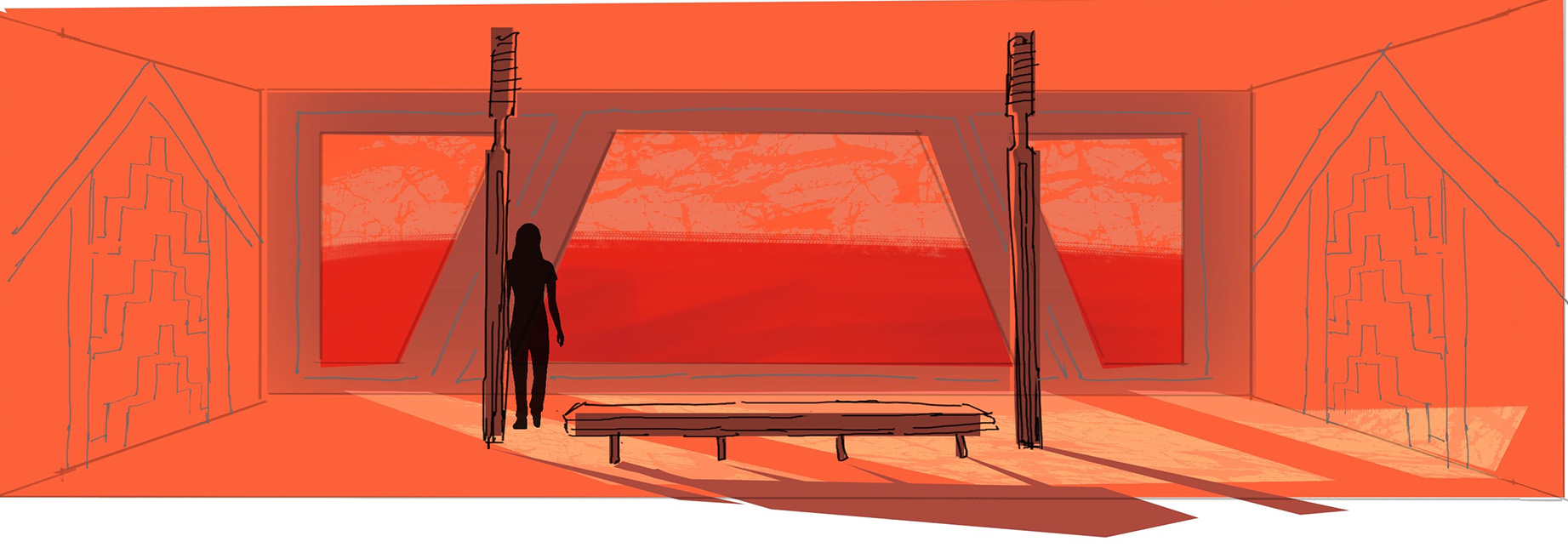
Concept art of the interior of the main lookout at Taniwha Station.
The Perfect Ocean
Every great seafaring culture has a special relationship with the ocean. But few cultures in human history have had the ocean so completely at the center of their identity as the Māori. The ocean is not a background in Māori mythology: it is Tangaroa, one of the great gods, the source of life and the destination of the dead. It is the medium through which the world was made possible.
So when I decided that Kiwa, our exoplanet, would be covered entirely by a vast red ocean, with no land, no shore, no horizon that leads anywhere except more ocean, it felt less like a creative decision and more like an inevitability.
Kiwa is the paradise of navigators. It is the Olympus of the Māori gods. An ocean larger than anything on Earth, on a planet more massive than Jupiter, stretching in every direction without interruption. If Tangaroa rules the seas, then Kiwa is his throne .
And at the center of that ocean floats a tiny station, crewed by people who are very far from home, carrying their identities with them the only way humans know how: in their art, in their stories, in the name they gave their ship.
Red Dreams is a love letter to the Māori spirit.
Since Captain Cook first arrived on the shores of Aotearoa, the Māori have never stopped astonishing the world. They navigated the largest ocean on Earth with nothing but stars and courage. They built a culture of extraordinary beauty and resilience in one of the most remote places on the planet. And they have survived every attempt to erase them, emerging with their identity not just intact but celebrated.
Red Dreams is, among other things, a love letter to that spirit. To the idea that no ocean is too vast, no void too dark, no distance too great for those who know who they are and where they come from.
The Red Ocean is waiting. And the Māori have always been ready to sail..